
Summer Reads
not at the beach

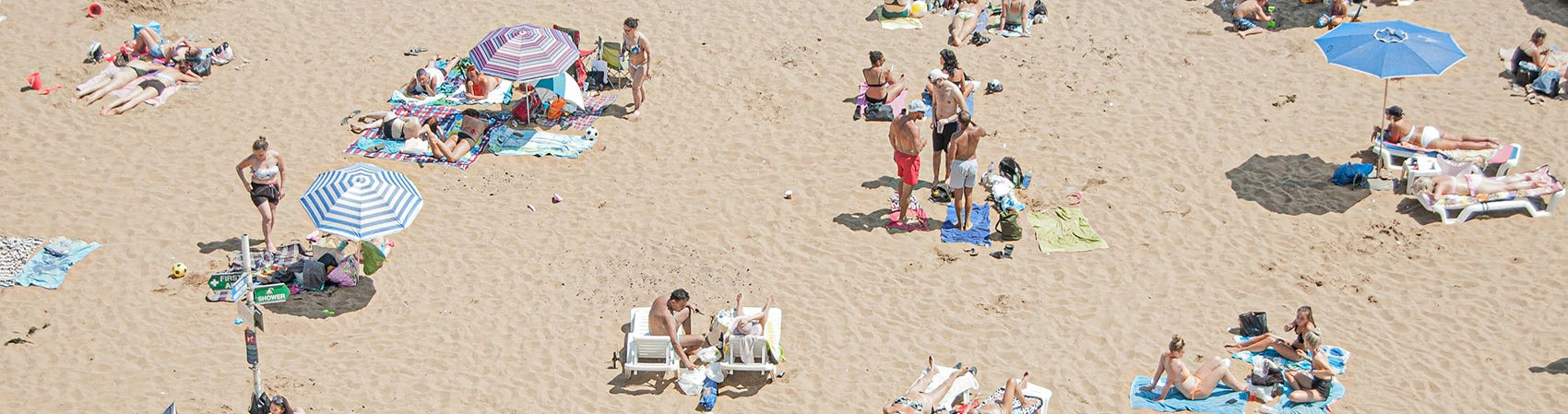
Granta contributors, friends and staff share what they are reading this summer.
Lamorna Ash
I trace this summer reading’s origins to last May when I met James Schuyler’s poetry in José Esteban Muñoz’s Cruising Utopia. I’m years late to every seminal queer text, like I am just reading Jack Halberstam’s The Queer Art of Failure. But that’s another story, and why am I using ‘lateness’ as a metric for reading, anyway, as if you turned up to books as you did movie screenings. The poem was ‘A Photograph’, in which Schuyler sorts ecstasy into two kinds, that which you recognise as ecstatic while it’s happening, and ecstasy revealed as such only in retrospect, like ‘that joy I felt / and didn’t think about / when his feet were in / my lap’. Ever since, I’ve been falling hard for Schuyler. This summer I’m rereading his collected poems, especially The Morning of the Poem. In interviews Schuyler suggested his compositional method was to look out the window, then put down what he sees. But that’s to conceal a lot of strenuous underwater paddling. I read, too, Nathan Kernan’s excellent recent Schuyler biography, A Day Like Any Other. Schuyler had these terrible manic periods where he’d think he was Christ. From Schuyler I have travelled down the New York School to Joe Brainard (he once wrote to Schuyler, ‘Please save anything you run across that has anything to do with bananas.’). Brainard’s masterpiece, I Remember, is a quick and wonderful book of memory snapshots all beginning with the refrain ‘I remember’. Writing it, he said, made him feel ‘very much like God writing the Bible. I mean, I feel like I am not really writing it but that it is because of me that it is being written.’ Finally (I don’t know how to segue elegantly here, so I won’t) I just read Eve Esfandiari-Denney’s forthcoming poetry collection, Girling, and it was so astonishing I imagine its poems will continue to resonate and send me off in new directions (in reading, in living) for the rest of the summer, and far beyond it.
Amie Barrodale
I’ve been reading The Complete Eightball comics, which feels so different now. It used to be like an electric jolt, coming across it somewhere (e.g. noticing an issue at Other Music around 1998 and starting ‘Like a Weed Joe’, a story about maybe Clowes spending a summer with his grandparents. In one of the first panels, they’re sitting at the table eating dinner, and the grandfather says, ‘Now this has a good . . . oh, you know . . . medicine . . . no. God damn it!’ I was standing there laughing in a tense hysterical way, uncertain at the time if I’d understood, if the joke was intended. I showed it to my friend, who was embarrassed that I was behaving like a monkey. She read it and then gave me a confused look and wandered away). Now, reading Eightball comics feels like swimming in someone’s subconscious, reinvigorating. Like I’ve undergone some kind of shamanic treatment. Reassembling some diminished part of myself. I’ve just started David Shields’s Failure is the Only Subject, and it’s catching me in exactly the right mood, these descriptions of documentaries, massive inconceivable, unspeakable failures in life, parenthood. (Some of the stuff he writes about in the documentaries is actually unspeakable, and he just describes it the same way he describes the dynamic between Steve Coogan and Rob Brydon, no bullshit.) Intercut with descriptions of a consuming love affair with a documentary filmmaker. I am not done with the book, and the last chapter I read made me wonder if it was mostly long distance, the affair. Not, of course, that that would even matter. On the contrary.
Brodie Crellin
Missouri William’s The Vivisectors broke my heart with its elliptical expression of what it feels like to open yourself up to love. The closing image of a relationship distilled into two hands touching, and the decision to choose to believe in a white whale’s enduring existence, moved me deeply. The greatest love story ever told! Few books have reached me like this, perhaps because it has been so hot, making everything feel pixelated, sweaty, diffuse, and to counter the heat I’ve returned to the grounded and dependable sentences of Willa Cather. The cold expanse of Nebraska, by way of My Ántonia, and the Christmas visit to Manhattan in My Mortal Enemy, have both brought sweet relief from the heat inside my studio flat. Otherwise I have been rereading Parallel Lives, to remind myself that a relationship where the pair of you can’t agree on the story is not worth having, and making notes in my proof of Eve Esfandiari-Denney’s Girling, out in September, which will change everyone who encounters it.
Zoe Dubno
This summer I’m in France on what I’m calling my Erasmus because I’m on a month-long trip trying to get good at French. The first night as a kind of joke my boyfriend booked a room at the ‘Hotel Gustave Flaubert’ in Rouen where, in an interesting design choice, they have passages from his novels written out in stickers on the headboards of the beds. Ours was from A Sentimental Education – ‘Il voyagea. Il connut la mélancolie des paquebots, les froids réveils sous la tente, l’étourdissement des paysages et des ruines, l’amertume des sympathies interrompues . . .’ which was a thrill to translate but I’m trying to have more fun on my travels than my friend Moreau. So in addition to some classics of French literature (Cousin Bette, The Red and the Black) I’ve packed some fun reading to reward myself after trying to speak French to obliging old ladies and bored teenagers.
I’ve not started these yet but among the books I’ve packed are: My Search For Warren Harding which my friend Peter gave me, The Yahoo Boys by Carlos Barragán, in which the writer tracks down the men in Nigeria scamming his mother out of her money, Karan Mahajan’s The Complex which is a family political saga set in India, Barbara Pym’s An Academic Question which the bookseller at the LRB book store said I had to read as an academic WAG and fan of English comic novels written by the likes of Nancy Mitford/Barbara Comyns/Stella Gibbons et al.
Geoff Dyer
I’ve just started on two books, scheduled for publication in September and August respectively, with significant overlaps of interest and context. Deep into the Sixties is the latest increment (this volume covers the years 1965-66) of David Kynaston’s epic, ongoing and irresistible history of Britain from 1945 to 1979. John Berger: From Life is Tom Overton’s long-awaited biography of the great writer whose centenary will be widely and rightly celebrated on 5 November.
Nicole Eisenman
I’m on a Tove Jansson kick. She’s so good at landscapes. I’m halfway through The Summer Book right now, and I’m finding it very gratifying to read about a young girl and her grandmother adventuring to uninhabited Finnish islands while my cat and I lie about on my sweltering rooftop in Brooklyn. I relate to the grandmother’s constant napping (she will lie down anywhere) and appreciate her philosophizing on god and death. I’ll read Fair Play next, I hear it’s great.
Merve Emre
I may have been the only woman of a certain age and background who hadn’t read Norman Rush’s Mating. A friend once described it to me as ‘the book about cerebral women in love’ and I thought, ‘Give me a break.’ But I plucked it off a shelf last month and finished it over a weekend. It was too late in the day for me to thrill to its sexual politics; what drew me in were its visions of solitude. The novel’s finest chapter, ‘My Expedition’, has the narrator crossing the Kalahari Desert with her donkeys, Baph and Mmo. ‘My boys,’ she calls them. She and her boys are tracked by lions and assailed by the heat. A beautiful mania ensues. Mmo runs away. Baph collapses. No other reader, as far as I can tell, has paid much attention to the donkeys. I fell in love with them straightaway.
On the subject of sexual politics, I’ve been reading John Berger’s fiction, from his first novel, A Painter of Our Time, to his last, From A to X. Novelists can be plotted along two axes: those with ideas and those without; those who repeat and those who reinvent their form. Berger falls into the quadrant that interests me most, novelists with ideas who reinvent their form. His triumph is G., about a modern Don Juan who loafs around Southern Europe at the turn of the twentieth century. G.’s form is reckless – a Cubist collage of dialogues, essays, epigrams, news reports, sheet music, and a few naughty sketches, all of which lets Berger interleave the erotic pursuits of one man with the political pursuits of the masses. A novel this loose has no business working. And yet, it does. It may be the closest any English writer has come to writing a truly non-bourgeois novel.
Camilla Grudova
I love biographies, I always like to have a life, or an approximation of one alongside mine. Peter Ackroyd’s new biography of Auden, which I heard had some good descriptions of Auden squalor, is on my list. Reading Ackroyd can be like watching someone who loves to eat snails and oysters, eat snails and oysters. I am also reading Red Pyramid: Selected Stories of Vladimir Sorokin, translated Max Lawton. Read ‘Obelisk’ in it! And you thought I was scatological! My soul is in pain and crisis so I have Tolstoy’s A Confession and Other Religious Writing (translated by Jane Kentish), and Seneca’s Dialogues and Essays (translated by John Davie). ‘On the Shortness of Life’ is actually so useful and reassuring. All contemporary self-help is mumbo-jumbo, you just need Seneca.
I want to live inside the first movement of Beethoven’s Piano Concerto No. 5, it’s an entire life with all its different emotions and moods, the way the piano runs off and weeps and mutters in a corner then returns to society . . . I am at risk at floating away with it so I’m going to read Thomas Mann’s Doctor Faustus, about a musicologist, to not become a Thomas Mann character myself. And I’ve put a biography of Beethoven on reserve at the library, it doesn’t matter which one – there are too many options in the world and I like being limited by my local library. I want to measure out the chamber pots and crumpled sheet music, cakes and fleas which existed underneath the concerto, a pile of broken crockery falling from a thunder cloud. More knowledge, especially ruinous knowledge, is always a danger the novelist can’t resist. Finally, Cynics by Anatoly Marienhof, translated by Bryan Karetnyk. With Petronius and enema jokes inside, it feels like it was written just for me.
Jeremy Harding
Last month I plunged into Vasily Grossman’s war dispatches (From the Front Line: Stalingrad, Treblinka, Berlin – 1941-45, translated by Robert and Elizabeth Chandler). Grossman drew on several of these pieces for Stalingrad, his magnificent war novel published in English in 2019. He was embedded with the Red Army as it fought its way from the Volga to Berlin. With few exceptions, these reports are cluttered with the fallen masonry of Red Army propaganda, plaudits for Soviet heroism and eulogies to a people under arms. But that was Grossman’s brief and when he crossed a line, his editors showed no mercy. And yet we already sense a writer with a gimlet eye for detail, instinctive empathy and a grasp of the epic scale on which his two big novels would unfold. (‘During the whole war,’ he wrote, ‘the only book that I read was War and Peace.’) This selection includes on the spot dispatches, as well as meditative pieces from Treblinka and Warsaw, where he walked the rubble of the ghetto to commemorate the uprising. There are also sketches that teeter on the cusp of fact and fiction, as well as a short story, set in the Tiergarten Zoo as the Russians closed on Berlin in the spring of 1945. It’s told from the viewpoint of an elderly keeper and his captive animals, including the love of his life, a gorilla by the name of Fritzi, for whom he used to set out food in plates and saucers like a loyal retainer, along with a cup of Moselle before the going got rough. As Soviet armour rumbles through the streets, the zoo animals imagine herds of unfamiliar species on the move, never pausing, even at night. Fritzi doesn’t live to get a shot of victory vodka.
Rahmane Idrissa
I’ve finally begun reading Les divagations d’un nègre hippy and Shit, the two sixties novellas by Abdoulaye Mamani, which the resolutely eclectic French publisher L’Harmattan issued in a single volume in 2017. They were previously unpublished. Though I picked up a copy not long after its release, I haven’t finished either work yet, so I’m in no position to say much about their substance. But they are a surprise to me.
Mamani, who died in a road accident in 1993, is mostly known for Sarraounia (1980), a novel that was ostensibly about the Hausa queen who opposed a crazed French colonial column in 1899, in what is now central Niger. Sarraounia had, to me, the peculiar lack of appeal of books one feels obliged to like. The rest of Mamani’s published oeuvre consisted of only a handful of obscure poetry books and an unremarkable short story.
Then, in the early 2010s, his family made accessible a trove of manuscripts. No less than six novels came out in 2014, chronicling episodes of colonial conquest and postcolonial tribulations. And in 2017, the last and strangest of this post-mortem outpouring came out: Divagations and Shit.
As far as I can tell at this stage of my reading, the book amounts to a sustained assault on the West’s sacred cows – capitalism, Christianity, and colonialism (old and neo). It wages that assault in a language that draws on raunchiness, slang, and satire to strip bare the sordid fears and busy hypocrisies of which those cows are made. This is the speech of a global anarchist, a stance perhaps possible only to someone from the colonised world, since the global hierarchy is the product of colonial imperialism. And in true anarchist form, the speech is refracted through a chorus of many voices, the loudest belonging (it currently seems to me), to African-American figures encountered in the underworld of European capitals.
That, incidentally, carries us to the other side of the looking glass from the distinctly American gaze James Baldwin – writing some years earlier – cast on the Africans he spotted in Europe, and to whom he never allowed a voice.
But to say much more at this point, when I have not yet finished, would be indiscreet. Suffice it to add that the book, even in its fiercest outbursts of rage, speaks with startling clarity to the present moment. At a time when the West – now overshadowed by the grotesquely representative figure of Donald Trump – appears to lose its cover, as it were, Mamani’s voice sounds uncannily legible, and what he was trying to say comes through with unusual force.
Paul Keegan
A survivor of totalitarianism, Czeslaw Milosz wrote in praise of those artists ‘for whom the link of a bracelet, the clasp on a dress, the carriage of a head, has seemed worth the effort – because one can only get at man obliquely, through the constant masquerade that is the extension of himself at a given moment.’ I am reminded of this while reading Analogue Africa, a collection of Jeremy Harding’s ‘notes’ on the anti-colonial imagination at work, in pre- and post-independence Africa, with asides on some exemplary Europeans.
The political and historical detail is exact, underpinned by Harding’s travels and reportage of several decades. But his focus is on particulars, not propositions: individual case histories of African filmmakers, photographers, artists and novelists who have reimagined the colonial encounter in variously oblique moves. His Europeans include Michel Leiris, anti-colonial ethnographer and sometime Surrealist, whose commitment to action was tempered by his belief that only a shift in consciousness would defeat the stereotypes. Analogue Africa bears witness to many such triumphs.
Josie Mitchell
This summer I was in Czech Silesia for a friend’s wedding, near Jeseník, on the Polish border – twenty kilometres as the crow flies from the setting of Olga Tokarczuk’s Drive Your Plough Over the Bones of the Dead. For the train journey from Prague to Silesia, I bought a copy of the Czech writer Bohumil Hrabel’s Closely Watched Trains, which is about a shy apprentice stationmaster, obsessed with his sexual inadequacy, who attempts to sabotage a Nazi-operated train.
An hour in, our train stopped on an empty stretch of the tracks, and there was a tannoy announcement. The woman sharing the carriage explained that the train had stopped because we’d ‘bumped’ a person and killed them. Several hours later, the entire local train system was still down, and the conductor announced – again via the woman – we were being delayed because they were still looking for the body. After eight hours, we were all given a three-euro voucher to buy a chocolate bar or coffee. It did give me a chance to finish the book.
Hrabel is a good writer, and so en route home I picked up his book All My Cats, a memoir about all the cats he’s had across his life. It pairs well with Doris Lessing’s On Cats, which is about the same thing. Both books are incredibly violent and unsentimental, recounting a long tally of cat disappearances and deaths.
Lessing’s book catalogues the cats of her childhood – drowned in buckets, shot, poisoned and run over – in a way that manages to capture the normalisation of violence in colonial Rhodesia. Hrabel’s memoir describes his cat-filled house near Prague, in Soviet-controlled Czechoslovakia. At one point, he’s summoned to a local courthouse to defend the dozens of animals he owns and the damage they were doing to local birdlife. Hrabel takes it badly and threatens to kill a sack of kittens and then kill himself.
Thomas Meaney
Georges Simenon’s Le Coup de Lune (“Tropic Moon”) is the first of his romans durs. It’s set in Gabon during the one of the last spasms of French colonialism. A young man arrives with a letter from his uncle to set up shop in Libreville as an employee of a timber firm only to learn there’s no job. The woman who owns the only hotel in town sleeps with him the first night he’s there. He thinks he’s special until he learns that’s the way she works. On the same night her husband is killed and he thinks she’s covering something up. But then they go into business together. There’s a lot of high fevers, casual cruelty, courtroom drama, and a delirious journey to the “bush” and back, and no lack of whiskey or sang-froid in the telling. It reminded me a bit of Paul Bowles’s Let It Come Down.
Sarah Nicole Prickett
Summer is for perennials. In June, you have to read Sleepless Nights: ‘This is what I have decided to do with my life just now.’ In July, the Jamaica Kincaid story about the Fourth, the one where her dad tells her to ‘always go with the cool kids’. I forget what August will bring. I’m trying to read more contemporary fiction, after realizing ‘I don’t read new novels’ is the new ‘I don’t watch TV.’ But what’s more unfair, ill-paid critics being snobbish or the fact of so many ‘major’ ‘new’ ‘novels’ being written for the clear and express purpose of being turned into streaming shows?
Still, I am reading new books again. I do care what people are trying now. I like alternating old and new: Elizabeth Bowen’s The Death of the Heart and Brodie Crellin’s A Sense of Occasion. Renee Gladman’s The Activist and Camonghne Felix’s Let the Poets Govern – a meal and a cocktail (you could say Molotov). Next I’ll be reading Tove Jansson’s Fair Play in my long-distance book club for two with my ex (do I need to say lesbian) and Bobuq Sayed’s No God But Us, which seems a less apposite pairing, but you never know. I read Afternoon Hours of a Hermit and interviewed Patrick Cottrell, that was a spiral. I read The Tunnel, godddddddd. I’m very slowly reading Nasser Abu Srour’s The Tale of a Wall. Books are made of so much time. The best are often written in some kind of confinement: physical, psychic. I made that up, but seems true.
Not summer-y, but: I’ve been re-reading Sylvia Wynter on plot and plantation. Everyone should. Ditto Fredric Jameson on novels and narrative. Due to tragedy I felt I was losing language for a while, so now I have to learn again how to write, how to think. I’m trying to be more complete in my thinking, conquer my romantic inclination to have, or to make, readers finish my thoughts. Jameson has a total system, and it works. Or I’m working more.
Not reading, but being read to: I went to a Metonymy Press reading in Montreal the other day to hear Nora Treatbaby perform her poem on rent. My third time hearing her perform it and I’m convinced, this is one of the most intelligent and idiomatic texts of the new decade, a better polemic than most essays on the political economy of x y z. Made me emotional even though she rushed it this time, anxious about the score of the FIFA World Cup game. Bad news, Cape Verde was losing to Argentina. ‘There’s no justice,’ she said.
Aea Varfis-van Warmelo
I’m looking for structure and accountability this summer so I have founded and will be running a two-person book club where we will read one book and one book only: Grapes of Wrath. I’m not sure why I want to read this so badly that I’m willing to let admin (the enemy of pleasure) get involved, but it’s possible that London’s rolling heatwaves have made me feel some kinship with the Dust Bowl, or perhaps they’ve laid the ground for the broad and biblical moral theatre Steinbeck excels at.
Janique Vigier
I’m halfway through The Collaborator by Alice Kaplan, her study of the 1945 trial and execution of the French fascist writer and editor Robert Brasillach, which summons so much about the political winds of the twenties and thirties blowing through the Parisian literary world. Those who defended Brasillach said he ‘only set words to paper’, which reminded me of a line from Rene Ricard in his piece about Julian Schnabel when he’s describing some phenomenon in a painting and a peer says, scoffs really, ‘That’s just how the paint is put on.’ Ricard: ‘Doesn’t he realize that’s all there is; the way the paint is put on?’ I’m also halfway to the beach, which means I’m not there yet, but I picked up Magda Szabó’s The Fawn, which seems casually brutal. Summer is melancholy enough without adding sentimentality to the mix.
Missouri Williams
Every couple of years I reread Hermann Hesse’s The Glass Bead Game, and I’ll be doing that again this summer, for sure. Sometimes I wish I lived in Castalia, somewhere arid and abstract and full of idiosyncratic pursuits, but filled with a sense of noble if fantastically useless purpose. By way of contrast, I’ve been revisiting St. Augustine and attempting The City of God for the third time. St. Augustine sees history as a conflict between the worldly and the spiritual, the transient and the eternal, the City of Man and the City of God. I usually get stuck in the polemical opening, though, where he lists all the things that are wrong with Rome and the pagans, so I guess I’ll never know how to reach the right City. Hannah Arendt’s Love and St. Augustine, which is based on her 1929 doctoral thesis, has been a great companion on this botched endeavor. It’s interesting to see how many of her later ideas can be traced back to this student dissertation, as every page seems to introduce another hard hitter, but more than anything, I like the idea that loving the neighbor is a big challenge, a problem that Arendt wants to solve, because I really hate my own neighbor and don’t know what to do about him. More recently, Patrick Cottrell’s Afternoon Hours of a Hermit is brilliant, and I’ve not found a book so funny in years. There are some great moments of camaraderie between strangers, such as when the narrator, a deeply invested investigator of his bemused family, is approached by a concerned security guard: ‘I was watching you, man, said a security guard. I watched you pacing around. You looked like you were about to give up on life!’ People are always trying to reach one another, although often failing spectacularly.
Image © Ferran Feixas
Josie Mitchell's entry is the one that got me. A train kills someone, the whole system's down for eight hours, everyone's handed a three-euro voucher, and the note she lands on is that it gave her time to finish the book. She doesn't raise her voice once. That flat register carrying that much weight is the thing I'm always chasing and mostly missing.