
Pure Proust
Dushko Petrovich Córdova on men’s perfumes from the '80s

Whether they have little or no interest in perfume, most American Gen X men will have strong and specific memories of Drakkar Noir and Polo Green. If you give them a spritz on their wrist now, as I like to do unannounced at dinner parties, you will see a range of real-time emotions cross their face as they flash through first loves, older brothers, sleepaway camps – their many early attempts at manliness.
The appeal of such colognes was obviously the instant manhood they imparted, but smelling them now I realize they are the olfactory equivalent of a brown wool suit. Drakkar is an aromatic fougère, the longest-standing genre of men’s perfumes, and perhaps the last great fougère. It is herbal, circumspect, brooding. Polo is even darker, an ominous leather forest lurking just behind Ralph Lauren’s bright, preppy aesthetic. A teenage boy wearing either of these is ridiculous – a put on. But we all did it; we didn’t know we were so painfully out of sync.
Thinking about how desperately we were trying to jump forward in time made me realize that I had unwittingly caught up to the colognes of my youth. What was wrong could be made right, and doubly so: for Gen Xers, Drakkar and Polo are now both totally nostalgic and, finally, age-appropriate. I thought it would be funny to go back to wearing them for just this reason, as a kind of bit. To put the 80s and the 2020s in stereo sound.
You can get a bottle of current Drakkar Noir for about $13, so that was easy. The Polo is pricier, around $50 a bottle, so I just got a 2 ml decant. The instant effect is, as described, pure Proust. If you stay with them a little longer, however, you start noticing differences from the smell you remember. It is surprising that a forty-year-old memory can be this specific, but it is: the 2026 Drakkar hovers very close to the 1987 Drakkar, but it feels thinner, more diaphanous. I remember it sharper, eye-wateringly so. I was a child in those days so maybe any cologne would have burned my eyes. I am smelling it through the veil of memory, so I concluded that this veil was diluting the perfume’s impression on me now, but I had the opposite experience with the Polo: the leather smell is far stronger than I remember. Animalic is the word perfume reviewers use. Maybe this adult funk was imperceptible to me as a child, unnamable. Or maybe Polo has just messed up the leather in its reformulations. I am tempted to get in touch with Carlos Benaïm, Polo’s legendary perfumer, and ask, but I imagine he can’t comment, for contractual reasons, or maybe because the slow disfiguration of one’s early-career masterpiece is too painful to acknowledge.
I mentioned all this to my friend Charley Friedman, and he told me he smelled current Polo in an airport and was confused by how much it had changed. Later that day, into evening, Charley sent me text updates as he looked for his old bottle of Polo, first in his own basement, then over at his mom’s. Meanwhile, I started looking online for solutions and found a dupe company called Classic Match that sells $8 knock-offs of Drakkar and Polo that online connoisseurs swear are closer to the original perfumes than what Guy Laroche and Ralph Lauren (both now owned by L’Oreal) are currently putting out.
Charley never did find his bottle, just some very old Jägermeister, but my dupes arrived and, the truth is, they deliver. Rougher, perhaps, than the originals, but closer to my memory of them than the current official versions. The Drakkar burns your eyes, the Polo subtly darkens your soul. The dupe bottles look cheap, though, and like a partial victory. It’s like watching a cover band who actually sound how the original band used to, better than how the old band sounds now: it takes you back for a moment, only to spit you out into the undeniable present.
Dushko Petrovich Córdova is a painter, writer and publisher. His piece Secondhand Smoke appears in our Winter issue, No. 174: Therapy.
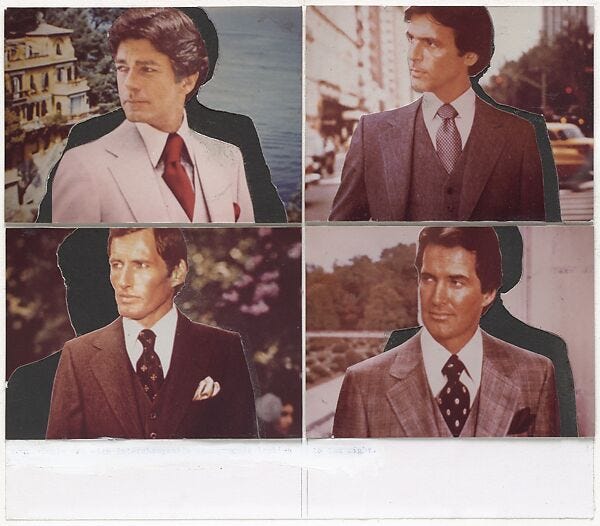
Image: Richard Prince, Untitled (four single men with interchangeable backgrounds looking to the right), 1977.